

Friday Flyer - February 6, 2026

Spotlight on the University of Notre Dame QuarkNet Center
The Notre Dame QuarkNet Center started the 2024-2025 academic year as it always has, with weekly meetings starting in September. The group met just about every Monday, chaired by Teacher-Mentor Pat Mooney with additional mentorship and participation by Notre Dame particle theorist Antonio Delgado.
World Wide Data Day was held on November 14, 2024 for classrooms all over the world. Two Notre Dame QuarkNet teachers took part with their students: Rebekah Randall at Canterbury High School in Fort Wayne IN and Jeremy Wegner at Winamac Community High School in Winamac IN. In addition, Jeremy brought students from Winamac to Notre Dame on March 13, 2025 to participate in international Masterclasses. Highlights included a visit to the Notre Dame Nuclear Structure Lab, and learning about the CMS experiment from Notre Dame experimental particle physicist Osherson. Scrolling ahead, Jeremy was back with students for World Wide Data Day 2025 on November 20.
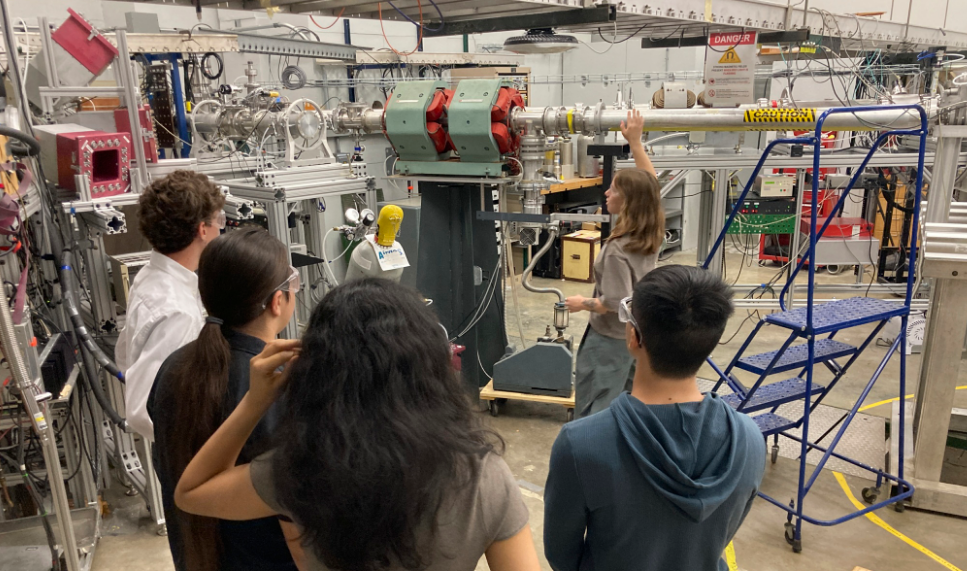
The next event - the biggest - was summer 2025 research. A total of 16 rising high school seniors were chosen to work with 10 teachers and 13 mentors. The research period ran for six weeks in June and July with an additional teacher “QuarkNet week” at the end for teachers to do QuarkNet activities and finish their research. Highlights of the research included moving a full detector module from the closed-out GRAND cosmic ray experiment on campus to the QuarkNet Center, explorations of CMS data and work on the CMS upgrade, cosmic ray studies including both the "traditional" QuarkNet Cosmic Ray muon Detector and the Cosmic Watch, and work on environmental sensors with physicists from Indiana University South Bend.

News from QuarkNet Central
QED: The next QuarkNet Educational Discussions will take place on Wednesday February 18, featuring a talk by NASA engineer Alice Bowman. Dr. Bowman will give a talk with the title, "New Horizons: NASA's Mission to Pluto and the Kuiper Belt." We will connect via Zoom (password hint: he wrote the book).
International Masterclasses 2026: Fermilab-based International Masterclasses will be held March 1-28, 2026. The registration link has closed but you can do a last-minute registration by emailing Ken. For all the latest IMC news, see the IMC circular from last week and today with an important updates on CMS masterclasses and measurement Question Times.
Perimeter Institute offers the EinsteinPlus Workshop for Teachers: Applications close on Monday for this well-regarded five-day workshop in July 2026. Learn more!
Beamline for Schools (BL4S) 2026: Proposal submission is open until March 13 for BL4S 2026. Students should follow this link to learn more about this competition, to pre-register, or to submit a proposal.
Mentors and Lead Teachers: The QuarkNet RFP form is still available. Time is running short to request the resources you need for your 2026 QuarkNet program. If you haven't done so already, please complete this form as soon as you can.
Physics Experiment Roundup
Let's start with CERN Bulletin, where we learn that CMS has completed its prototype of the High-Granularity Calorimeter (HGCAL) for the High Luminosity LHC; HGCAL will be the largest silicon-based detector ever made. We also learn that CERN is at work on probing asteroids with particle beams at the HiRadMat facility.
In APS Physics, we find an up and a down (not spin) (not quarks). Up, for gravitation theory: LIGO-Virgo-KAGRA studied the ringdown from gravitational wave event GW250114 and found that the frequencies and decay rates matched General Relativity. Down, for dark matter, so far: the magnetic field of the earth just might act as a dark matter sensor...but no such signal yet.

Resources
Let's take a literary diversion. APS Physics suggests that science fiction can inspire and maybe anticipate future technologies. Hard to argue: from HAL 9000 as AI to all that tech in Star Trek, we already see examples. On the other side of the question, novelist Nova Jacobs has taken to murder mysteries set in the world of physics.
More on the theory side but still in APS Physics, we have an article on those magic numbers that seem to make nuclear physics work.
Just for Fun
Let's pick up where we left off in the Resources section with some related videos. Of course, in 2001: A Space Odyssey, HAL is not only a prediction of future tech but also the culprit in a murder mystery, minus the mystery. Of course, the iconic scene is not about HAL but Strauss and spaceflight. The same scene enters into an extended version of the Star Trek: Enterprise opening. [Warning: the STE opening is, uh, not universally loved.]
About that future tech: we're working on a possible cloaking device (thanks TED-Ed), first seen in Star Trek.
Off we go then, with some xkcd and a bit more xkcd.
QuarkNet Staff
Mark Adams: markadams74@gmail.com
Ken Cecire: kcecire@nd.edu
Spencer Pasero: spasero@fnal.gov
Shane Wood: swood5@nd.edu