

Friday Flyer on Monday - February 23, 2026

Spotlight on QuarkNet Summer Camps for Teacher 2026
The words “summer camp” might bring to mind campfires, s’mores, and afternoons by the lake. But a QuarkNet summer camp adds a different set of memories: data analysis, collaboration with colleagues from across the country, and classroom implementation plans. This summer, QuarkNet is offering two immersive professional learning experiences bringing QuarkNet teachers together from around the country: Coding Camp 1 and Data Camp. This week’s spotlight highlights these opportunities and how you can be part of them.
Coding Camp 1 will be held virtually via Zoom from June 29–July 3. During this week, teachers learn to code in Python, analyze authentic physics data, and build pathways for bringing computational thinking into their classrooms. Applications for Coding Camp 1 are due March 27, 2026. For more information and application details, visit the Camp 1 page or contact Coding fellows Tracie Schroder (bravesearth@gmail.com) or Carol Burns (burnscarol2020@gmail.com).
Data Camp will take place July 12–17 in person at Fermilab. Teachers engage in rigorous particle physics data analysis, dive deeply into QuarkNet Data Activities, and take full advantage of learning at a world-class national laboratory. Applications for Data Camp 2026 are due March 16, 2026. To learn more and apply, visit the Data Camp page or contact Jeremy Smith (tlquarknet@gmail.com).
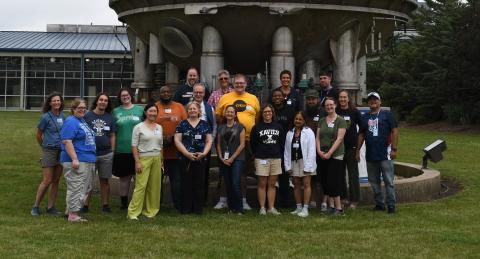
QuarkNet camps are also great places to meet new friends, or to meet up with long-time buddies and pals.
Image

News from QuarkNet Central
International Masterclasses 2026: Fermilab-based International Masterclasses will be held March 1-28, 2026. The registration link has closed but you can do a last-minute registration by emailing Ken. For all the latest IMC news, see the IMC circular from February 13 (measurements and data sets) and February 20 videoconferences.
Beamline for Schools (BL4S) 2026: Proposal submission is open until March 13 for BL4S 2026. Students should follow this link to learn more about this competition, to pre-register, or to submit a proposal.
Data Camp and Coding Camp 1: Check out the Spotlight section above for information about these camps, including links to applications.
QuarkNet at KITP: The Kavli Institute for Theoretical Physics (KITP) in Santa Barbara is hosting a QuarkNet workshop on Friday, April 3, followed by their 2026 Teachers' Conference on biophysics on Saturday, April 4. You can register for one or both days by the March 2 deadline, with Saturday's conference wrapping up early at 3 PM for the holiday weekend. See the Teachers' Conference webpage for more information, including a link to the application. Be sure to apply early for priority consideration for KITP's travel financial aid, and join Ken, Shane, and fellow QuarkNetters at the event!
AAPT PhysicsBowl Contest: Registration is open until February 25 for the 2026 PhysicsBowl Contest. Learn more from the PhysicsBowl website.
Physics Experiment Roundup
At the LHC, scientists recreated conditions like the first millisecond after the Big Bang, detecting for the first time a tiny “wake” behind a quark in quark-gluon plasma, suggesting this primordial matter behaved like a liquid soup rather than a simple gas of particles. Meanwhile, researchers are developing machine learning algorithms to reconstruct complex collision events more precisely and efficiently than traditional methods, an important advance as the LHC prepares for even higher data rates. In accelerator infrastructure news, full-scale tests have begun on key systems for the High-Luminosity LHC upgrade, a project that will boost collision rates by an order of magnitude. Also at CERN, the HEARTS facility is using heavy-ion beams to test radiation effects on electronics destined for space, showing how particle beams serve applied science as well as basic research. At the U.S. Brookhaven National Laboratory RHIC, data from proton collisions reveal a direct window into the quantum vacuum’s role in forming real particles.
On the quantum physics frontier, two pieces from Quanta Magazine: one explores how decoherence may be dissolving long-standing mysteries about the quantum-to-classical transition, and another reports on experiments that are making electrons flow collectively like a fluid.

Resources
We'll start with an Even Bananas video that explores the question, "Is dark matter hiding in the neutrino fog?"
This month’s The Physics Teacher offers several articles worth checking out. "Questions Without Answers as a Teaching Tool" highlights how open-ended questions can spark deeper student thinking and discussion in physics lessons. "Dinosaur Gigantism and Conservation of Energy" uses prehistoric scale to make the conservation of energy tangible and engaging for students. Finally, "The Physics of Auto-transforming Robot Toys" presents hands-on investigations with toys that illuminate mechanics and energy principles in ways students will enjoy. Also, check out the Fermi Question section, along with sample solutions.
Winners of the 2025 Interactions Global Photowalk were recently announced, highlighting images of experiments, equipment, underground tunnels, detectors, and the environments of the 16 laboratories that participate.
Learn about the Sanford Underground Laboratory's (SURF's) 2026 Artist in Residence, and read about Fermilab's 2026 guest artist and composer.
Just for Fun
An article from The Onion (self-claimed "America's Finest News Source") claims that an Olympic ski team was found tampering with Earth's gravitational field using a traditional kitchen implement. (About The Onion for those who are not familiar.)
From Under Studio: The "I Went to Yale" Interview, Training for IT professionals, and Nicknames for Coworkers.
From xkcd: Eliminating the Impossible and Cosmologist Carbon Dating.
QuarkNet Staff
Mark Adams: markadams74@gmail.com
Ken Cecire: kcecire@nd.edu
Spencer Pasero: spasero@fnal.gov
Shane Wood: swood5@nd.edu